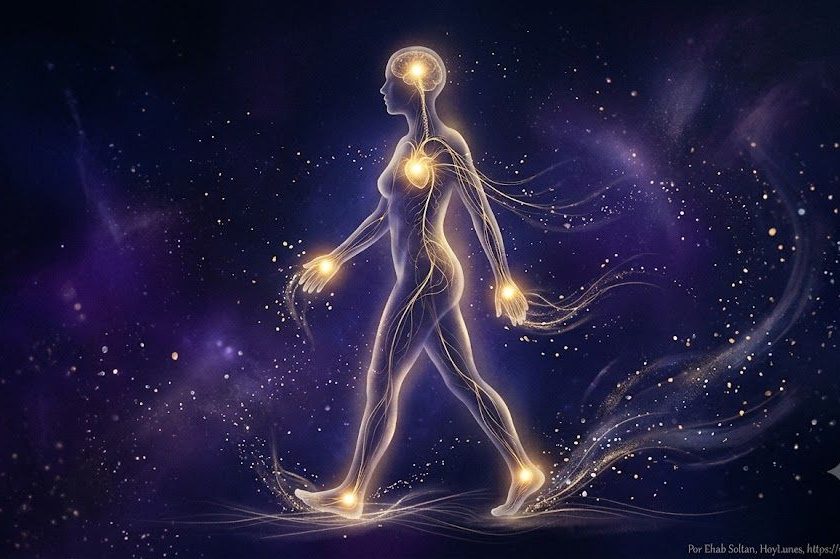

For thousands of years, human beings coexisted with silence while walking, waiting, traveling, or contemplating the world. Today, every pause seems to demand an immediate distraction. Science is beginning to question what happens to the brain, memory, creativity, and emotional well-being when these small spaces of encounter with oneself disappear.
By Ehab Soltan
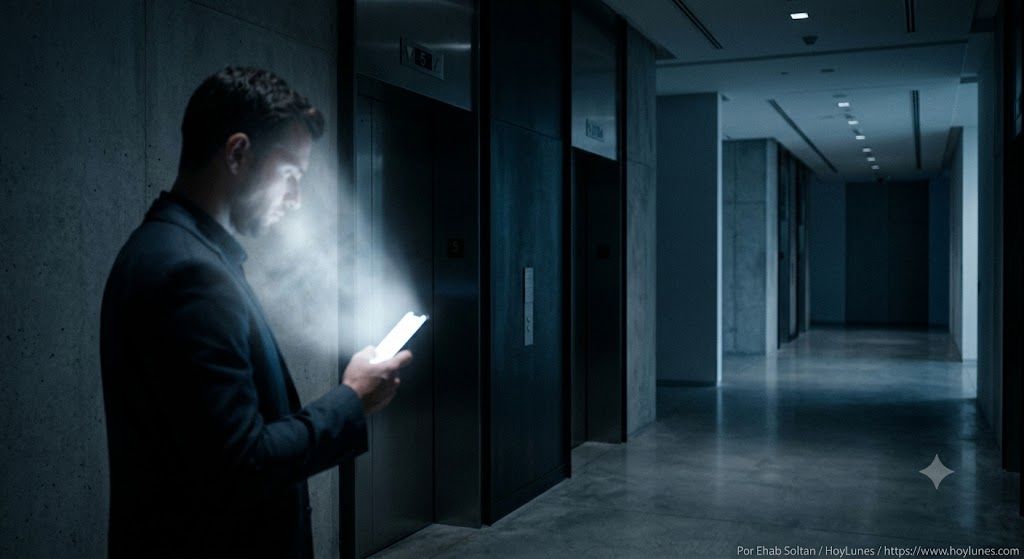
HoyLunes – A scene we all recognize. A man waits for the elevator. The light indicator marks the third floor, then the fourth. It will take barely twelve seconds to arrive.
He is not waiting for a crucial message. He has no missed calls. He does not need to check the map, the weather, or breaking news. Yet, his right hand descends almost reflexively toward his trousers pocket. He pulls out his phone, wakes up the lock screen, and swipes his thumb. He is not looking for anything in particular; he is merely looking to fill the void.
Today, those twelve seconds of transition are perceived as an unbearable anomaly, a rift in the continuum of stimulation that must be sealed immediately. At what point did we begin to feel that being alone with ourselves was a waste of time?
The Silence That Vanished Without Anyone Noticing
Without great cataclysms, humanity has carried out one of the most radical cultural experiments in its history: the eradication of idle time.
Traditionally, daily life was riddled with invisible seams. Waiting for the bus, standing in line at the bakery, traveling in a train carriage while watching the landscape, walking to work, or contemplating the rain behind a windowpane. None of those moments appeared on schedules as “productive time,” but neither were they dead time. They were, in reality, mental buffer spaces. Within them, nothing visible occurred, but many invisible things did.
There is a subtle yet crucial difference between the concept of free time and that of inner time. We have optimized the former through instant access to entertainment and information, but in doing so, we have suffocated the latter. What has vanished is not the availability of non-working minutes, but the capacity to inhabit our own minds without technological mediation.
The Brain Is Never Truly Inactive
For decades, neuroscience assumed that when a person stopped performing a goal-oriented task—such as solving a mathematical problem or drafting a report—their brain entered a state of lethargy or “energy saving”. We were wrong.
In the late 1990s and early 2000s, functional neuroimaging studies revealed a fascinating phenomenon: when we stop interacting with our physical or digital environment, an interconnected network of brain regions lights up with astonishing metabolic activity. Scientists termed it the Default Mode Network (DMN).
The DMN is the workshop where the brain organizes life from within. It is where an uncomfortable conversation makes sense, where a loss begins to find its place, and where an isolated experience is transformed into part of our personal history. Far from being a system failure, apparent “doing nothing” is the necessary biological condition for the brain to grant meaning to experience through memory consolidation, autobiographical processing, and emotional regulation.
“The brain takes advantage of moments of apparent rest to organize life from within: it is the necessary biological condition to grant meaning to experience.”
What Happens When These Spaces Disappear
When we systematically intercept every glimpse of boredom with a digital stimulus, we deprive the Default Mode Network of the fuel it needs to activate. Clinical and cognitive research is beginning to outline a landscape that goes far beyond simple digital eyestrain.
- Fragmented Attention: By habituating the brain to frequent cycles of novelty and reward, we raise the stimulation threshold required to maintain focus. The consequence is not that we lose the ability to pay attention, but rather that our attention becomes hyper-reactive and superficial.
- Lower Tolerance for Boredom: Boredom is the biological indicator that drives us to seek meaning. When artificially suppressed through infinite scroll, the brain loses the practice of tolerating the void, becoming incapable of sustaining complex and deep thought processes.
- Processing Overload Fatigue: The mind does not rest when reading a thread of opinions or watching short videos; it continues to process data, faces, words, and visual micro-stimuli. By eliminating assimilation pauses, the brain accumulates a processing deficit that translates into chronic, diffuse exhaustion.
- Difficulty Metabolizing Emotions: Complex emotions—grief, disappointment, guilt, or uncertainty itself—require time and mental digestion to be understood. Emotions need silence for the same reason that wounds need rest. Some emotions do not disappear when we ignore them; they simply wait on the psychic periphery until we find enough silence to listen to them.
“Emotions need silence for the same reason that wounds need rest. If we never grant it to them, the discomfort becomes chronic.”
Creativity Is Born Where Distraction Ends
The history of science and art is, to a large extent, the history of banal moments. The principles of hydrostatics did not strike Archimedes while facing a papyrus of equations, but in the bathtub. Charles Darwin conceived some of his most audacious theoretical breakthroughs while walking the “Thinking Path” in the gardens of his home in Down.
Most people have lived a similar experience: suddenly remembering a solution or having a brilliant idea during a shower, a walk, or a routine commute. Neurobiology demonstrates that truly original ideas rarely emerge under pressure or during information saturation. Creative thinking depends on divergent thinking, a process nurtured directly by the Default Mode Network. The best answers do not usually arrive when we actively pursue a solution, but when we leave the space free for it to emerge on its own.
The Longest Relationship of Our Life
There is an uncomfortable paradox in contemporary society: we invest vast amounts of time and resources into nurturing relationships with friends, partners, followers, and work colleagues, but we systematically neglect the most enduring bond of our existence.
If we are to coexist uninterruptedly with someone from birth until death, that person is ourselves. It is paradoxical that we know the opinions of strangers on the internet better than some of our own thoughts. We fear the background noise of our doubts and prefer any external noise, no matter how banal, to facing the echo of our own thinking. We have become strangers inhabiting the same body, mediating our coexistence through a screen.

What Specialists Are Beginning to Observe
From psychiatric consultations to evolutionary neuropsychology laboratories, more and more specialists are observing similar trends. Mental health professionals report a notable increase in patients experiencing a profound disconnection from their own internal processes, manifesting a sort of introspective illiteracy.
Professionals are not solely concerned with total screen time, but rather with functional displacement: what vital activities technology is cannibalizing. Current medical consensus suggests that 21st-century mental hygiene will not consist so much in adding therapies, but in ecologically restoring spaces of cognitive fasting.
It Is Not About Abandoning Technology
Adopting a Luddite stance or suggesting a utopian return to the pre-digital era is a lazy and sterile response. The real problem does not reside in the tool, but in the absolute colonization it exerts over our time. Smartphones are extraordinary instruments of connection, knowledge, and management. In fact, much of the research warning about these changes relies precisely on advanced digital technologies to observe them.
The thesis of this analysis is not that technology is harmful. The thesis is that the human brain functions through rhythms of **systole and diastole**: it needs external data input, but it requires internal processing with equal urgency. Keeping the brain in a state of perpetual reception is as unsustainable as attempting to inhale air continuously without ever exhaling.
The Test Anyone Can Do Today
To verify the validity of these claims, one does not need to design a randomized clinical trial. It is enough to test our own cognitive resistance through an elementary, everyday experiment.
The next time you find yourself waiting for an elevator, standing in line to pay for a coffee, or awaiting the arrival of a bus, set yourself an unusual challenge: do not pull out your phone. Observe your surroundings, let an idea float, bring a memory to mind, or allow your mind to wander for two or three minutes. If discomfort appears in less than a minute, perhaps that feeling is more revealing than any subsequent result. By resisting that first automatic impulse, the inner voice—the one that usually remains buried beneath the noise of the data stream—takes the floor once again.
The light indicator finally reaches the current floor. The elevator stops with a slight hiss, and the metallic doors slide wide open.
The man from the first paragraph slips his phone into his pocket before crossing the threshold. He enters the cabin, turns around, and presses the button for his destination. The doors close again, isolating him from the corridor.
Barely twelve seconds have passed. A ridiculous fraction of time, mathematically insignificant within a day and clearly insufficient to transform the course of a life. However, perhaps the most silent revolution of our era has not been carrying a computer in our pocket, but ceasing to frequently visit the only place from which we can never leave. Those twelve seconds have been enough to remind us that, sometimes, the most urgent and priority place where we can choose to be is, precisely, inside our own thoughts.